
NFV-RI™
Delivering unparalleled energy and resource efficiency for the telco network infrastructure
Overview






Virtualized and cloud-native infrastructures are becoming increasingly critical in CSPs' deployments as 5G implementations progress. Their workloads have stringent KPIs, like deterministic performance, high throughput or low latency, which often requires using the underlying infrastructure in inflexible and inefficient ways to achieve them. For instance, dataplane VNFs are keeping the servers where they run constantly at a high power-up state, as if they are always operating for peak demand. Similarly, operators deploy critical functions typically in isolation, reserving upfront a large portion of server resources in order to prevent contention from other services, and therefore Service Level Objectives (SLOs) violation. But in this way a large portion of infrastructure remains unutilized.
Intracom Telecom's NFV-RI solution addresses the above challenges by employing AI to right-size the hardware resources of telco network workloads easily, automatically, and dynamically. It offers a wide range of workflows that make it possible to decide the ideal allocation of resources, while always maintaining performance Service Level Objectives. Intracom Telecom's NFV-RI guarantees optimal execution of the telco workloads and optimal utilization of the infrastructure where they are running.
Highlights

Energy savings up to 45% on servers running packet-processing VNFs/CNFs (e.g. DPDK-based), by dynamically adjusting their power according to the anticipated traffic load

Energy and cost savings up to 30% on bare-metal and cloud-based data centers, by strategically powering off underutilized servers

Accurate and reliable resource predictions, backed by powerful robustness mechanisms to guarantee resilience and uninterrupted service delivery in the face of unforeseen events (e.g. load spikes)

Non-intrusive to the VNFs/CNFs, requiring zero extra modifications, integration, or exposed metrics

Agnostic and transparent to the server chip, VNF/CNF, and middleware vendor

Seamless and versatile integration across a variety of bare-metal, virtualized or containerized environments

Validated and certified Reference Architecture, with streamlined deployment and fast time-to-market utilizing standardized technologies (Kubernetes, Helm)

Secure, stable and enterprise-ready solution, certified by Red Hat through the Red Hat Ecosystem Catalog

Small resource overhead per server, utilizing less than 50% of a single CPU core
Applications
Energy optimization of user-plane network functions
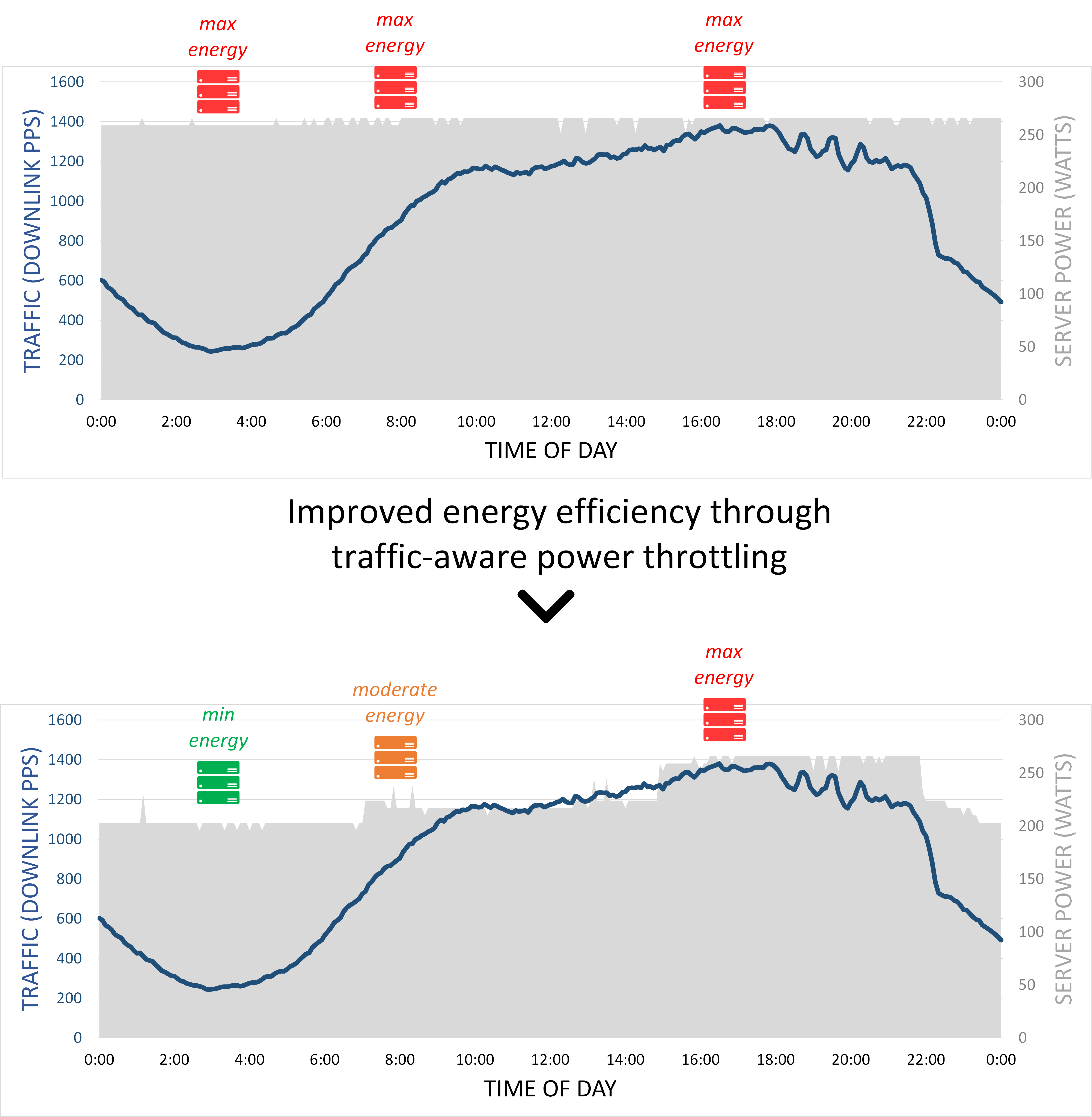
User-plane functions like 5G's UPF have stringent KPIs, such as low latency, zero packet loss, and high throughput. To meet them, network functions usually employ frameworks like DPDK, which rely extensively on polling to ensure carrier-grade packet processing performance. Polling forces the server platforms that host the functions to always be running at a high power-up state as if they were operating for peak demand. Even during periods of zero or very light traffic, the servers consume the maximum possible power.
NFV-RI™ provides AI-driven closed-loop mechanisms to dynamically manage the power of user-plane network functions in line with their load, while guaranteeing zero packet drops. In this way, their server platforms are operated at significantly less power during off-peak periods, contributing to overall energy saving.
In an initial PoC with a Greek Tier-1 CSP, NFV-RI™ achieved a 14% reduction in total server power consumed for a vEPC node prototype over a 24-hour period. In similar PoCs that followed using 5G UPFs, NFV-RI™ achieved significant average daily power savings reaching up to 45%.
Dynamic data center sizing
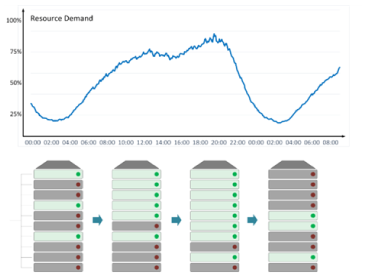
In the ever-evolving landscape of telco digital transformation, the data center (DC) is taking up a prominent position, where network functions, cloud services, business platforms, and IT operations tend to integrate within a converged infrastructure. Daily fluctuations in user activity create peak demand during the day, leading to server underutilization during off-peak hours and unnecessary energy consumption.
NFV-RI™ addresses this challenge in both bare-metal and cloud-based data centers, by proactively adjusting server workloads and strategically powering off underutilized servers to conserve energy, without compromising workloads performance and stability. Leveraging historical data for accurate demand forecasting, a decision-making module identifies the optimal servers to power off during low-demand periods or power on during high-demand times.
In a multi-day, real-word evaluation on AWS, NFV-RI™ demonstrated impressive results in a Kubernetes cluster with 34 EC2 nodes, reducing EC2 instances and costs by up to 31% while maintaining optimal performance.
Energy-efficient 5G Core slicing
Deploying multiple network slices with distinct performance characteristics poses a significant challenge for CSPs, requiring careful resource allocation to key network functions within each slice. Determining how to translate performance-level intents, potentially involving multiple metrics, into server resource decisions is complex.
NFV-RI™ addresses this complexity with AI-based workflows, simplifying the delivery of customized performance for 5G Core slices in a fully automated manner, minimizing resource usage.

Users declare performance-level intents (e.g., latency, packet drops, throughput), and NFV-RI™ autonomously determines resource allocations, whether for static, one-off allocations or dynamic adjustments in response to varying load conditions.
Demonstrated in an ETSI ENI PoC, NFV-RI™ successfully achieved specified latency and packet drop objectives for collocated 5G UPFs serving different priority subscriber groups. This fully automated process resulted in resource efficiency, translating to energy savings ranging from 16% to 43%, depending on the scenario. NFV-RI™ streamlines the intricate task of resource allocation, ensuring tailored performance with optimal energy footprint across diverse 5G Core slices.
Edge colocation without performance compromises

Edge environments are consolidating a disparate mixture of workloads (mobile core functions, RAN components, over-the-top services, etc.), increasing software density and diversity in a way that introduces uncertainty on how colocated workloads interfere with each other when running on common platforms.
NFV-RI™ enhances workload density on edge servers without compromising performance Service Level Objections (SLOs). Through sophisticated mechanisms, it slices shared server resources and allocates a private share to critical workloads, eliminating contention and allowing for denser workload placement. Utilizing AI, it dynamically determines the optimal resource allocation for each workload, ensuring performance levels comparable to standalone execution.
In various scenarios involving diverse performance-critical workloads (e.g., 5G UPFs, vRouters, high-performance message queues, web servers), NFV-RI™ achieved a remarkable increase in server density, up to 2x, while colocating with additional applications. Notably, the performance of the primary workloads remained fully protected, akin to running on a dedicated server.