Articles
Rethinking Fixed Wireless Access: Why Purpose-Built mm-Wave Systems Have the Advantage

Purpose-Built mm-Wave FWA vs 3GPP-based FWA
Purpose-built millimeter wave (mm-Wave) Fixed Wireless Access (FWA) systems are increasingly viewed as a superior alternative to 3GPP-based 5G FWA for high-capacity broadband delivery. While 3GPP technologies were originally designed for mobile networks serving smartphones moving across wide geographic areas, purpose-built mm-Wave FWA platforms are optimized specifically for fixed broadband. The result is significantly higher spectral efficiency, lower network overhead, and better economics for dense broadband deployments.
The main weakness of 3GPP-based FWA is spectral efficiency. In mobile networks, a large percentage of radio resources is consumed by mobility management, signaling, synchronization, handovers, random access procedures, paging, and support for devices operating at different speeds and radio conditions. These features are essential for mobile phones but largely unnecessary in a fixed wireless environment where customer terminals remain stationary.
Purpose-built mm-Wave FWA systems eliminate much of this overhead. Because subscriber units are fixed and precisely aligned, the network can use highly directional beams with stable modulation schemes and minimal control signaling. This allows a much larger percentage of the available spectrum to be devoted to user traffic rather than protocol overhead. In practice, purpose-built systems can achieve spectral efficiencies several times higher than those typically seen in 3GPP 5G deployments.
Another limitation of 3GPP technology is its dependence on wide-area cellular architecture. 5G standards are designed to guarantee coverage continuity and mobility across large networks, forcing operators to compromise between coverage, capacity, and latency. Purpose-built FWA systems, by contrast, are engineered for point-to-multipoint broadband delivery in specific sectors or neighborhoods. They can therefore use optimized frame structures, deterministic scheduling, and highly asymmetric traffic patterns tailored to broadband consumption, where download traffic dominates.
mm-Wave Spectrum Utilization and Beamforming Advantages
This difference becomes especially important in mm-Wave spectrum bands such as 24 GHz, 28 GHz, 39 GHz, and above. Millimeter wave (mm-Wave) spectrum offers enormous bandwidth, but propagation distances are not extremely long and link budgets are highly dependent on beamforming precision. Purpose-built systems take advantage of this by using narrow beams, GPS synchronization or Packet Time Protocol from the network, and static link optimization to maximize bits-per-second-per-hertz performance. Many proprietary systems also support coordinated multipoint transmission and interference suppression techniques that are difficult to implement efficiently in standardized 3GPP environments.
The economics also favor purpose-built FWA in dense broadband scenarios. Because of lower spectral efficiency, 3GPP networks require more spectrum and more cell sites to deliver the same aggregate throughput. This increases capital expenditure, power consumption, and tower density. In urban environments where spectrum costs are high, poor spectral efficiency directly translates into reduced profitability.
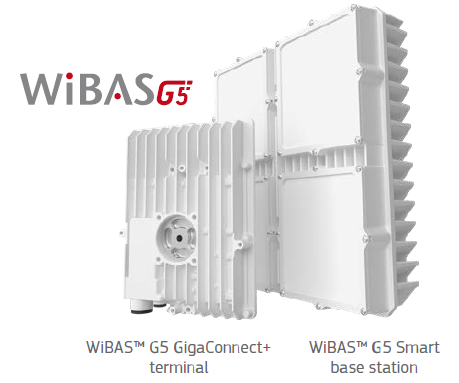
In addition, 3GPP systems often inherit complexity from the broader mobile ecosystem. Operators must maintain compatibility with evolving standards, handset ecosystems, roaming requirements, and multi-vendor interoperability. Purpose-built FWA systems are simpler because they are optimized for a single application: delivering fixed broadband. This allows vendors to innovate faster and tailor MAC-layer behavior, antenna design, and scheduling algorithms specifically for residential and enterprise internet access.
Latency, Determinism and Overall Efficiency
Latency consistency is another advantage. Since fixed systems operate with stable radio conditions and predictable traffic patterns, they can offer lower jitter and more deterministic performance than mobile-oriented 5G systems under heavy load.
Where the objective is maximizing capacity, spectral efficiency, and long-term broadband economics in mm-Wave spectrum, purpose-built FWA architectures are increasingly proving to be the more efficient and technically elegant solution.