OmniBAS-BX
All-Outdoor IP Multi-Gigabit MW Transmission

- Frequency
- 11 - 38 GHz
- Technology
- Point-to-Point
- Topology
- Last Mile, Access
- Location
- All-outdoor
- Management
- uni|MS

Overview
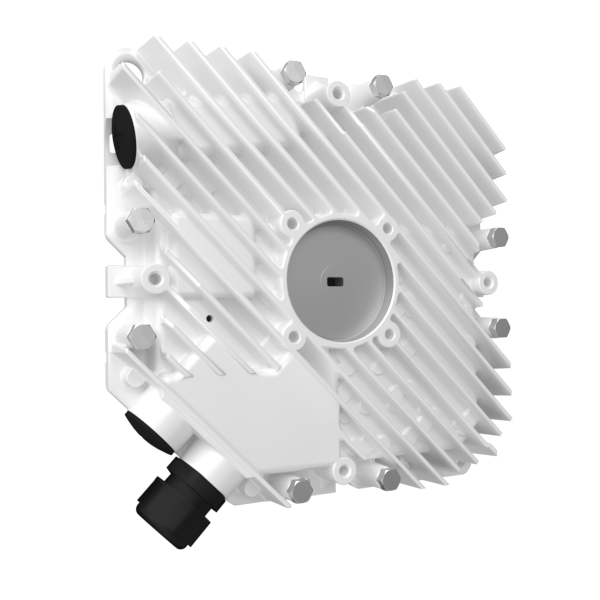
OmniBAS™-BX, the leading generation of single-core, all-outdoor radios of the OmniBAS™ Point-to-Point MW family, addresses the operator need for advanced, cost-effective, multi-Gigabit IP transmission solutions. It is ideal for both 4G/5G MW backhaul and for a wide range of enterprise wireless connectivity applications. Featuring an ultra-slim and low-weight mechanical design, OmniBAS™-BX covers a wide range of MW frequencies from 11 GHz to 38 GHz.
OmniBAS™-BX offers market-leading modulations up to 4096-QAM and channels up to 112 MHz (per unit), while employing advanced radio and traffic processing functionality to demonstrate exceptional MW radio performance. OmniBAS™-BX is compatible with both OmniBAS™ split-mount OmniBAS-BXd all-outdoor units. A broad range of peripherals and integrated antennas (0.3 / 0.6 / 0.8 / 1.2 / 1.8 m) complements the OmniBAS™-BX offering for complete MW link installations.OmniBAS™-BX is compatible with both OmniBAS™ split-mount and OmniBAS-BXd all-outdoor units.
Benefits
- Future-proof all-outdoor Gigabit IP MW solution for advanced MW transmission requirements.
- Market-leading modulation 4096-QAM (in channels up to 112 MHz per unit) and radio throughput.
- Support of XPIC 2+0 (using two units)
- Support of RLA 2+0 (using two units)
- Ideal for last-mile backhaul and all-outdoor small cells.
- Cost-efficient zero-footprint IP transmission for utilities, outside plants and rural communication networks.
- Compatible with both OmniBAS™ split-mount (IDU - ODU) and all-outdoor OmniBAS-BXd units.
- Powerful end-to-end service & network management.
- Environmentally-friendly.
- Part of Dual-Band all-outdoor solution (with UltraLink™-GX80)
Highlights
Being integral part of the OmniBAS™ MW portfolio, OmniBAS™-BX offers market-leading radio performance, excessive IP capacity and advanced traffic handling and control functionality.
Radio Features & Configurations
- Hitless adaptive modulation (4-QAM to 4096-QAM)
- Channels up to 112 MHz (per unit)
- Leading, full-duplex 1 Gbit/s radio throughput over a single 112 MHz channel.
- Leading 2 Gbit/s radio throughput over a single XPIC link of 112 MHz
- Pre-Distortion (PD) for extended range support and high availability even at higher modulations.
- LDPC and Reed Solomon FEC for robust operation.
- Configurations:
- 1+0
- 2+0 RLA (using two units)
- 1+1 HSB (using two units)
- XPIC 2+0(using two units)
NMS
- Managed by state-of-the-art element / network / service unified management suite (uni|MS™).
- Embedded Web Node Manager.
- SNMPv3, RMON and G.826 Statistics
- Radio Link Quality Monitoring (RLQM)
- SDN (NETCONF/YANG) capable platform
Ethernet, QoS & System Features
- IEEE 802.1Q (Virtual LAN) & IEEE 802.1p (QoS)
- IEEE 802.1ad (provider bridging, Q in Q)
- Packet classification per VLAN / P-Bits / DSCP / MPLS exp / IPv6 QoS
- Eight QoS queues; two-rate, three-color policer (2R3CP)
- SP / WRR / WFQ scheduling
- Jumbo Frames: 9,600 bytes
- MEF 9 & MEF 14 compliant for EPL and ELAN
- H-QoS
- Automatic ETH-BNM (G.8013 / Y.1731)
- IP / MPLS capable platform
- ITU-T G.8032v2 (Ethernet Ring Protection)
- IEEE 802.1w (RSTP), IEEE 802.1s (MSTP)
- IEEE 802.3ad (link aggregation ), static and LACP
- WRED congestion control
- Egress traffic shaping per port
- Encryption AES 256 (FIPS-197)
- LLDP
- System synchronization:
- Synchronous Ethernet (ITU-T G.8261 / G.8262. G.8264 (ESMC))
- IEEE 1588v2 TC
- Efficient Ethernet OAM , for end-to-end management.
- IEEE 802.1ag (CFM), ITU-T Y.1731 (PM), IEEE 802.3ah (EFM)
Applications
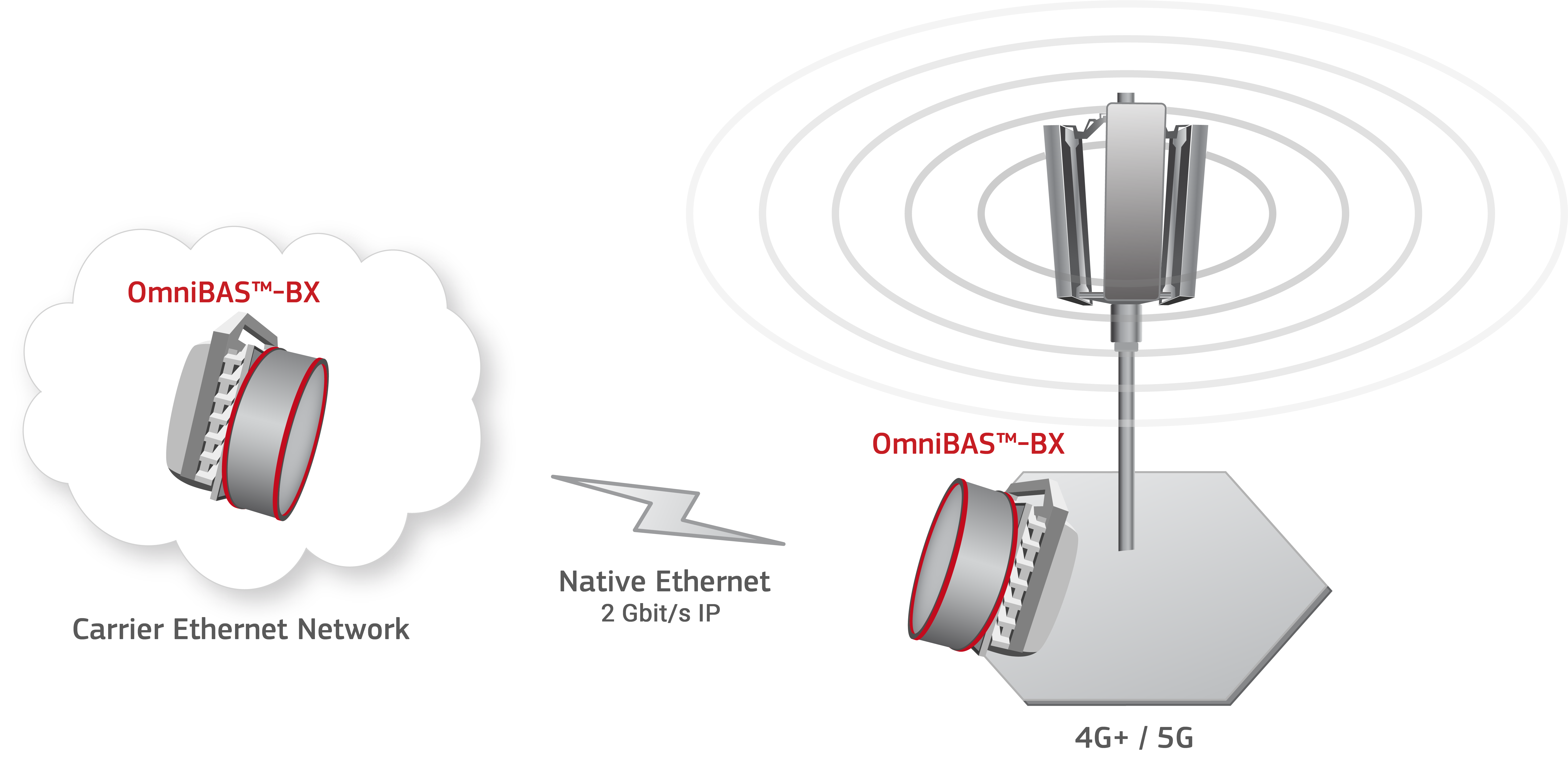
OmniBAS™-BX implements a large variety of network topologies for meeting the transmission requirements of:
- Last-mile mobile 4G/5G IP backhaul networks.
- All-outdoor small-cell deployments.
- All-outdoor IP MW transmission networks for Competitive Local Exchange Carriers (CLECs).
- Zero-footprint IP transmission for utilities, outside plants and rural communication networks.