Articles
Enhancing Wireless Transmission Performance by Deploying Licensed MW and Unlicensed Radios Dual Band Links
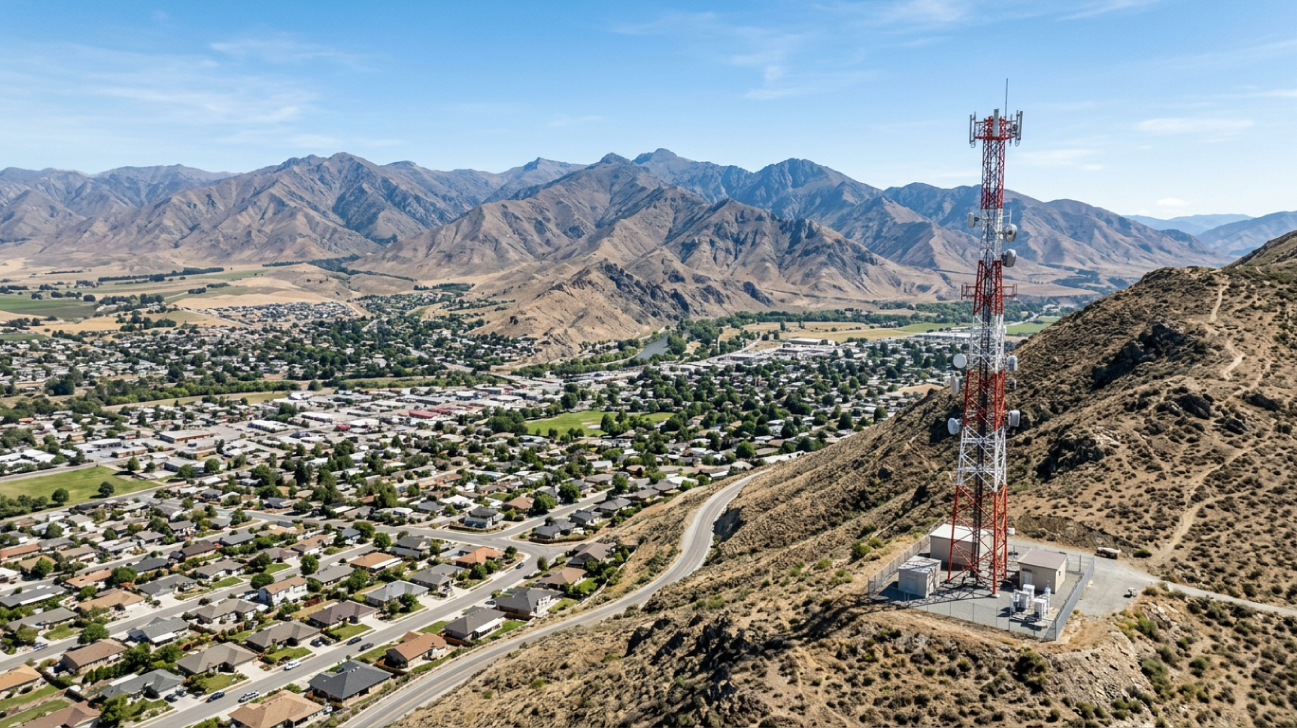
Wireless Microwave (MW) Point-to-Point (PTP) transmission systems play a significant role in empowering a wide variety of telecommunication networks because they offer muti-Gigabit IP capacity and can be deployed quickly and cost-effectively.
MW systems are used today in an extensive range of modern applications, such as ISP rural broadband, enterprise connectivity, public surveillance, and safety networks. The dominant use for licensed band MW radios remains that for backhaul to 5G networks, serving more than 70% of the live networks around the world. In parallel, unlicensed MW spectrum at lower frequencies is widely adopted for non-telco applications. The present article analyses the pros and cons of licensed and unlicensed MW spectrum and provides ideas for their optimal combination in Dual Band (DB) links.
Microwave Networks Deployment Scenarios and Challenges
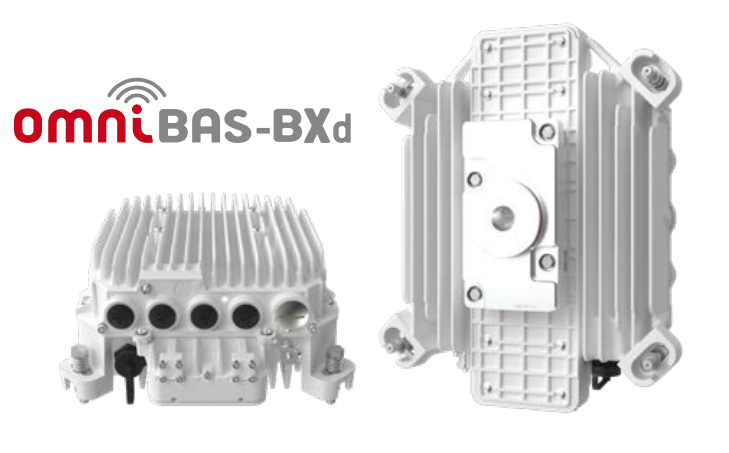
As we are moving further into the 5G era, the 5G mobile networks rollout is moving at full speed. To serve the ever-increasing 5G traffic, mobile operators continuously work at densifying networks in urban areas and expanding the 5G coverage in sub-urban and rural areas. A critical factor for cost-effective acceleration of 5G networks rollout is the availability of 5G capable MW transmission systems, like OmniBAS™ MW PTP product family, that are extensively used as the last-mile backhaul solution.
In addition, many telecom operators rely on unlicensed MW band radios to provide rapid wireless connectivity services to various enterprises and residential customers.
This section presents MW network deployment scenarios and analyzes their performance and operational challenges.
Licensed MW
Licensed microwave bands (6-38 GHz) are traditionally used for multi-gigabit carrier-grade communications because they operate in protected spectrum allocated by regulatory authorities. Since these frequencies are coordinated and controlled, they experience minimal interference from external systems. This allows licensed links to deliver predictable performance, stable throughput, and high reliability, making them appropriate for critical services and mobile networks backhauling.
Typical MW mobile backhaul systems in urban areas rely on bands in the upper part of the MW spectrum (13-38 GHz) and in combination with E-Band radios in Dual-Band (DB) links can offer speeds 10 Gbps or more. For longer link ranges required in rural and isolated areas, the lower MW spectrum (6-11 GHz) needs to be used. However, this part of spectrum is saturated in most countries, does not offer wide channels and has extremely high spectrum charges.
Normally, MW networks are professionally designed to offer high link availability, typically 99.99% or more. This is needed because MW links availability is affected by environmental conditions such as heavy rain, humidity, or atmospheric fading that can degrade microwave performance, particularly at higher frequencies. Depending on the link range and prevailing climatic conditions, achieving the desired link availability necessitates large antennas or more spectrum or more complex and expensive HW configurations.
Unlicensed MW
Unlicensed microwave bands (e.g., 5-6 GHz), on the other hand, offer greater deployment flexibility and lower equipment as well as operational costs because they do not require spectrum licensing fees. These bands can provide high-capacity, longer-range connectivity and rapid deployment, especially in urban or temporary network scenarios. However, unlicensed frequencies are more vulnerable to interference from nearby systems operating in the same spectrum.
That is why the unlicensed frequency bands have been used so far for enterprise connectivity networks, for ISP rural broadband, public surveillance, etc.
The following table compares the main technical performance and operational aspects of MW radios:
| Performance attributes | Unlicensed MW spectrum (5/6 GHz) | Licensed MW spectrum (13-23 GHz) |
|---|---|---|
| Capacity – Throughput (full duplex) | 1-3 Gbps | 2 Gbps (per radio) |
| Range | Medium - Long | Medium |
| Link Availability | Not guaranteed (can be higher if interference is avoided) | Can be designed for > 99.99% |
| Carrier grade | No | Yes |
| Networking functionality /QoS | Limited | Rich |
| Synchronization support | No | Advanced |
| Low latency | No (when based on WiFi standard) | Yes |
| Interference risks | High (unless they support interference mitigation) | Very Low |
| Equipment capex | Low | Moderate |
| Spectrum allocation | Not required | Required |
| Spectrum charges | No | Moderate |
| Heavy Rain attenuation | No | Yes |
Dual Band MW and Unlicensed Radios: Deployment Scenario and Benefits
To exploit the advantages of both licensed and unlicensed MW spectrum and alleviate their drawbacks many operators consider combining both technologies in Dual-Band (DB) links for demanding last-mile mobile backhaul and other time critical connectivity applications.
A typical configuration example of such a DB link is shown in the following figure:
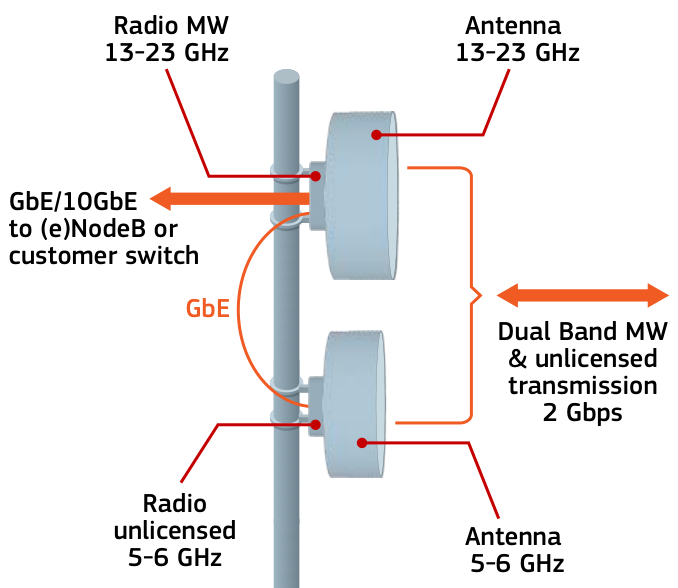
In this architecture, IP traffic from the mobile base station or other customer switches/CSR feeds the MW radio. Then the MW radio is connected to the unlicensed radio through a GbE interface. The MW band link acts as the primary reliable transport path, while the unlicensed band link supplements the link by providing redundancy.
The DB link can be deployed either as a greenfield complete solution or as expansion of an already installed unlicensed radio with a MW radios. In the latter case network traffic must be redirected to the MW radio.
The MW radio, thanks to its advanced networking and radio functionality, plays the role of the master unit. It continuously monitors signal strength and quality of MW signals and adjusts transmission parameters in real time. During periods of reduced signal strength, the system can lower modulation rates (throughput) using advanced Adaptive Coding and Modulation (ACM) algorithms to maintain connectivity rather than allowing the link to fail entirely. In case of severe MW link degradation or complete link failure due to heavy rain the master unit redirects the critical traffic to the unlicensed path. Note that operators can set the desired minimum MW throughput, according to supported modulations, where the traffic will be directed to the unlicensed radio. When environmental conditions improve again and the MW path is reestablished, then the MW radio reverts traffic from the unlicensed path to the MW.
To substantiate the potential benefits of a DB solution let us consider a MW link in New Delhi at 15 GHz using 0.6 ft antenna and 56 MHz channel in configuration XPIC 2+0 that typically offers 1 Gbps throughput.
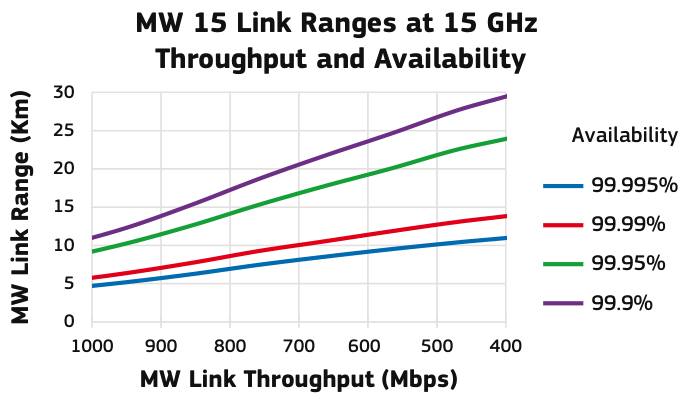
The following figure shows the maximum range that can be achieved for given speeds and various link availability planning targets. As an example, 1000 / 500 Mbps can be ensured at 12/27 Km with an availability of 99.9%, which means 525 mins unavailable time per year. Therefore, in these 9 hours per year that the MW network will not be available due to heavy rain, the unlicensed radio may provide continuous connectivity.
The key benefits of Dual-Band deployment are increased link availability and improved network resilience. Licensed MW links provide the stability required for mission-critical services and last-mile mobile backhaul, while unlicensed links can provide backup capacity during MW outages. This redundancy is particularly valuable for mobile network operators and other enterprise mission-critical services. Note that in case of Mobile Networks backhaul, GPS for network timing need to be employed by Base Stations to ensure continuous synchronization.
Dual-Band configurations may also facilitate cost effective capacity expansions in cases where the unlicensed radio can support essential networking/QoS functionality and low latency transmission. Expanding capacity solely through licensed spectrum can be expensive and time-consuming due to regulatory coordination. Adding an unlicensed link may enable operators to increase throughput quickly without significant additional licensing costs while still maintaining and enhancing the carrier-grade reliability of the licensed connection.
Another important benefit of DB links is that longer MW hops can be deployed by considering lower link availability design targets and/or using smaller antennas. The example of Figure 2 indicates that 1 Gbps MW throughput can be extended from 5 (99.995% availability) to 12 Kms (99.9% availability), thus increasing the effective MW hop length.
Conclusions
As wireless communication networks continue to grow, Dual-Band microwave architectures are becoming an increasingly attractive solution for reliable last-mile MW backhaul connectivity. A Dual-Band MW configuration that combines a licensed MW band link with an unlicensed band link provides an effective method for improving network availability and reliability. By leveraging the reliability of licensed spectrum together with the flexibility and additional capacity of unlicensed bands, telecom operators can achieve higher uptime, better performance, and more cost-effective network expansion.